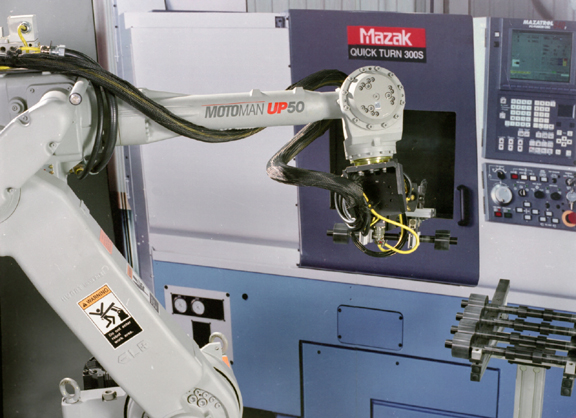
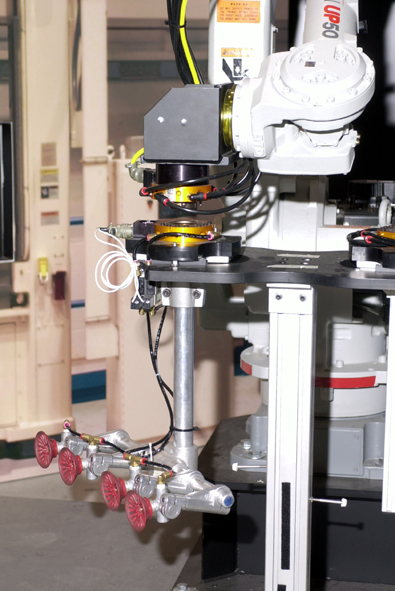
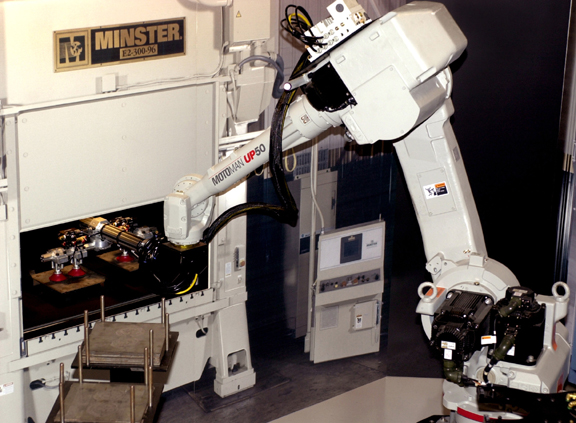
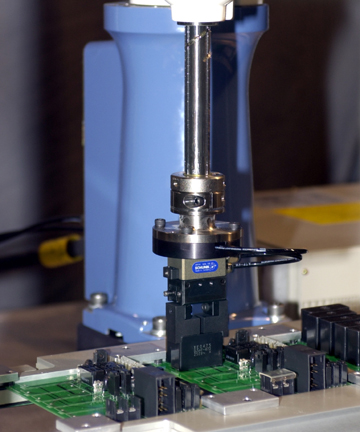
Machine loading and unloading
is a more complex application than basic material
handling; for this application, the robot provides
both manipulative and transport capabilities.
Robots can be used to grasp a workpiece from
a supply point (e.g., a conveyor belt), transport
it to a machine, orient it, and then insert
it into the machine workholder. This may require
that the robot signal the machine tool when
the workpiece is in the correct position, so
that the part can be secured in the workholder.
The robot then releases the part and withdraws
the arm so that machining can begin. Upon completion
of the machining, the robot unloads the workpiece
and transfers it to another machine or conveyor.
In a robotic cell, a single robot can service
several machines. The single robot may be used
to perform other operations while the machines
are performing their primary functions. This
may require that the robot be able to exchange
end-effectors.
Examples of machine tending functions
include the following:
Exchanging machine tools, such as lathe and
machining centers
Stamping press loading and unloading
Tending plastic injection molding machines
Holding a part for a spot welding operation
Loading hot billets into forging presses
Loading auto parts for grinding
Loading gears onto CNC milling machines